

What is Toncoin? Toncoin is the native coin of The Open Network (TON), the blockchain first designed by Telegram. Since June 2026 the coin is officially called Gram (GRAM). It pays for transaction fees, smart contract execution and data storage on TON, and it is staked by validators and used for voting.
This guide explains what Toncoin is, why it changed its name, how the TON blockchain works, what a transaction costs and where people keep the coin. Every figure comes from TON’s own site and documentation, linked at the end.
Key takeaways
- Toncoin and Gram are the same coin. Only the name and ticker changed, from TON to GRAM.
- The network keeps its name: TON, The Open Network.
- The coin pays fees, secures the network through staking and gives a vote on network changes.
- TON targets about 0.4 seconds per block and about 0.6 seconds to finality, according to ton.org.
Why is Toncoin now called Gram?
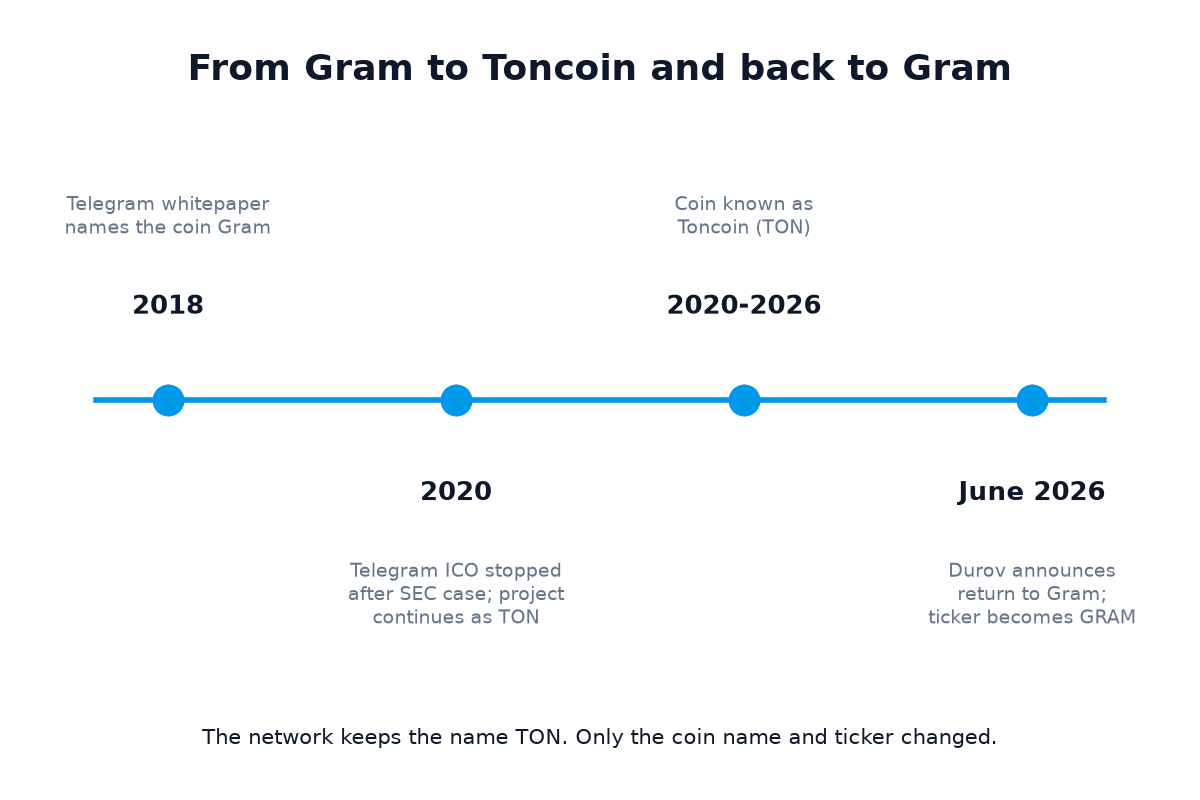
Toncoin was renamed Gram because Gram was the coin’s original name in Telegram’s whitepaper. Telegram founder Pavel Durov announced the change on 1 June 2026, and an on-chain vote opened the same day, with almost 80% of the coins pledged in favour when Cointelegraph reported on it. CoinMarketCap notes that TON keeps its name as the blockchain, while Gram becomes the name of the coin.
The history explains the double name. Telegram planned a coin called Gram, but its token sale ran into the US Securities and Exchange Commission. CoinMarketCap reports the case was settled in 2020, with more than $1.2 billion returned to investors and an $18.5 million penalty. The open-source community carried the network on as The Open Network, and its coin was known as Toncoin until 2026. You can read more about that early sale in our history of the Toncoin coin offering.
For holders nothing moves. The vote proposal, as reported by Cointelegraph, says there is no swap, migration, bridge, claim or conversion, and balances, addresses and contracts stay the same. Any website or message asking you to “claim GRAM” is not part of the rename.
What is Toncoin used for?
Toncoin, now Gram, is used to pay for everything that runs on TON and to secure the network. TON’s documentation says it pays for the execution of smart contracts, the storage of their data and network traffic. The official TON site adds validation and voting.
- Fees: every transfer and contract call is paid in the coin.
- Storage: accounts pay a small rent for the data they keep on chain.
- Validation: validators stake the coin to produce blocks and earn rewards.
- Voting: holders and validators vote on network changes, as they did on the rename.
- Inside Telegram: ton.org says Telegram Stars can be bought with the coin, Telegram Premium and giveaways can be paid with it, and ad payouts can be made in it.
TON also runs its own services. TON DNS gives blockchain domain names, and TON Storage handles decentralized file storage, both listed on ton.org.
How does the TON blockchain work?
TON is a blockchain of blockchains. A masterchain keeps the global configuration and system smart contracts, and a basechain holds most accounts and user contracts. The basechain is split into shardchains. TON’s documentation says the number of shards changes with network load: shards split when traffic rises and merge when it falls.
| Item | What TON says | Source |
|---|---|---|
| Workchains today | Two: masterchain (ID -1) and basechain (ID 0) | TON docs |
| Sharding | Shard count set dynamically by network load | TON docs |
| Block time | About 0.4 seconds | ton.org |
| Time to finality | About 0.6 seconds | ton.org |
| Consensus | Proof of stake, Catchain 2.0 | ton.org |
| Validators | 375 validators and 736 nodes (25 Nov 2026) | ton.org |
| Virtual machine | TON Virtual Machine (TVM), stack based | TON docs |
TON also works in parallel. The official site describes TON as based on an actor model that performs operations in parallel. For a closer look at sharding tools, see our guide to TON sharding technology.
Who validates TON and how does staking work?
Validators secure TON by locking up the coin as stake. TON’s documentation says an Elector contract takes applications, sorts candidates by stake and picks the validator set for each round. Validators earn rewards from transaction fees and configured block rewards. If more than two thirds of validator weight approves a complaint, a fine is taken from the offender’s frozen stake.
You do not need to run a server to take part. TON’s site says liquid staking lets users stake from 1 Gram with instant withdrawals, through staking protocols built on the network.
How much does a TON transaction cost?
A plain coin transfer on TON costs about 0.00039 Gram, and a USDt transfer about 0.001 Gram, according to ton.org, which says these fees are fixed and do not depend on network load. Behind that figure, TON’s documentation splits a fee into gas for computation, a storage fee for data kept on chain and a forward fee for sending messages.
Storage fees matter for idle accounts. TON’s documentation says an account that falls behind on storage fees is frozen until they are paid, and can eventually be removed. TON also supports gasless transfers, where the fee is paid in the token you are sending.
What can developers build on TON?
On TON every account can hold code, and code on an active account is a smart contract, as the documentation puts it. Contracts run on the TON Virtual Machine. Most new contracts are written in Tolk, TON’s official language, while FunC and Fift are kept for older contracts.
The biggest audience for those apps is Telegram. Mini apps inside the messenger connect to TON wallets through TON Connect, which our guide to Telegram Mini Apps explains in detail.
Where do you keep Toncoin?
You keep Toncoin, now Gram, in a TON wallet. The official site says a non-custodial wallet from the Telegram team is built into the messenger, so you can hold the coin without installing anything else. TON’s documentation names V5R1 as the latest official general purpose wallet contract.
- Write down your 24 recovery words offline. TON’s documentation says the wallet keys are usually derived from them.
- Never type those words into a website, a bot or a “claim” page.
- Send a small test amount before a large transfer.
If you are comparing the coin with other projects, our list of cryptocurrencies people are watching and our notes on TON token presales cover the wider market. Nothing here is investment advice.
Frequently asked questions
Is Toncoin the same as Gram?
Yes. Gram (GRAM) is the current name of the coin that was called Toncoin. The official TON site lists the coin as Gram and notes that it was also known as Toncoin. The network itself is still called TON.
Do I need to swap my Toncoin for Gram?
No. According to the vote proposal reported by Cointelegraph, the rename involves no swap, migration, bridge, claim or conversion, and balances and addresses stay as they are. Treat any site asking you to claim or migrate coins as a scam.
Is TON the same thing as Toncoin?
Not quite. TON, The Open Network, is the blockchain. Toncoin, now Gram, is the coin used on it to pay fees, take part in validation and vote. The old ticker for the coin was TON, which is why the two names were often mixed up.
Who created TON?
TON describes itself as a layer 1 blockchain developed by Telegram and the open-source community. Telegram planned the network in its original whitepaper. After Telegram settled with the US SEC in 2020, the project continued as The Open Network.
Does TON use proof of stake?
Yes. The official TON site says changes to the blockchain need approval from the majority of validators through proof-of-stake consensus, using a protocol called Catchain 2.0.
Sources: ton.org, Gram, TON documentation, Start here, Cointelegraph, 2 June 2026, CoinMarketCap Academy. Checked 25 November 2026.