

TON staking means locking Gram (formerly Toncoin) with the validators that secure The Open Network in return for a share of their rewards. For most holders that means liquid staking, which ton.org says starts at 1 Gram with instant withdrawals. Nominator pools recommend 10,000 GRAM, and running a validator takes at least 300,000.
This guide covers each way to stake, where the rewards come from, the risks TON’s own documentation lists and how to start from a wallet. Figures come from ton.org and docs.ton.org.
Key takeaways
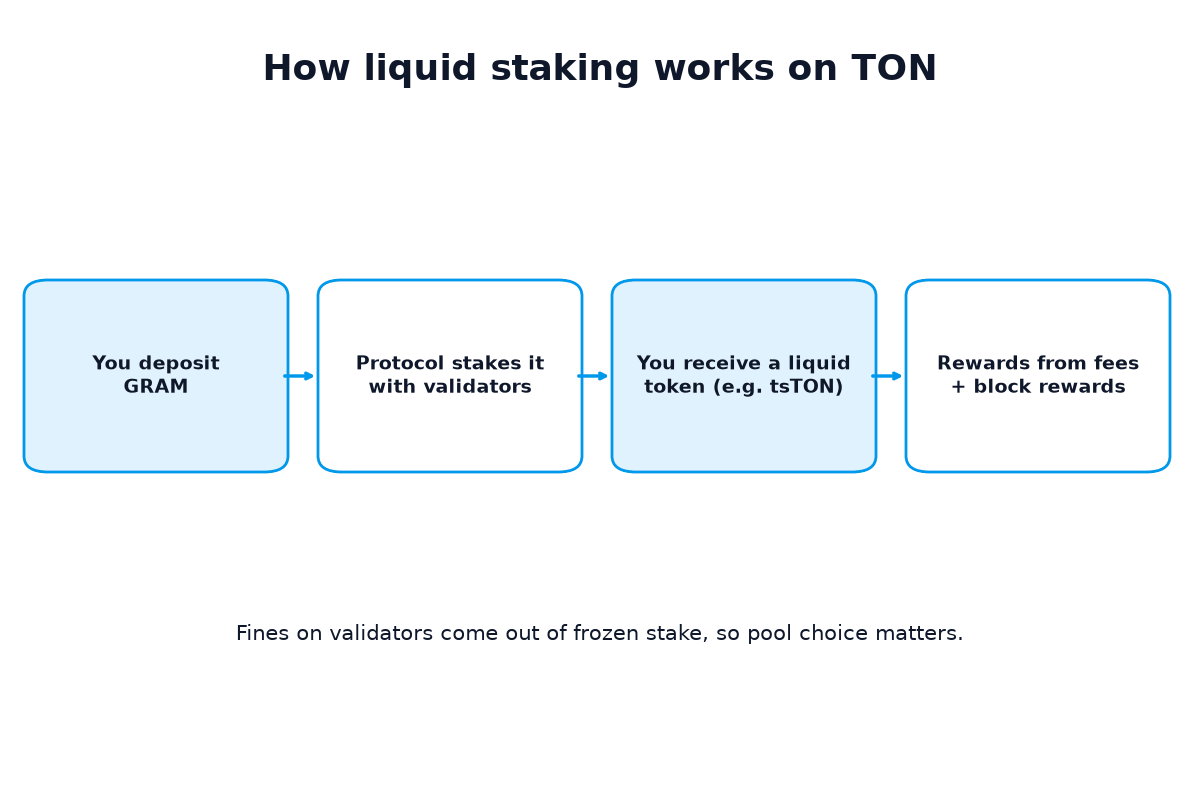
- Liquid staking: from 1 GRAM, you get a token such as tsTON back.
- Nominator pools: 10,000 GRAM recommended, up to 40 nominators per pool.
- Validators: 300,000 GRAM technical minimum, about 1,000,000 in practice.
- Rewards come from fees and block rewards; fines come out of frozen stake.
How does TON staking work?
TON uses proof of stake: validators lock coins and take turns producing blocks. TON’s documentation says an Elector contract runs validator elections, validation rounds and reward distribution. Validators receive gas fees plus block rewards when their frozen stake is released after a round. Holders who do not run a validator lend their coins to one through a pool or a liquid staking protocol.
What are the ways to stake TON?
| Method | Minimum | Who it suits | What the docs say |
|---|---|---|---|
| Liquid staking | From 1 GRAM | Most holders | You receive a liquid staking token such as tsTON; withdrawals described as instant on ton.org |
| Nominator pool | 10,000 GRAM recommended | Larger holders | Up to 40 nominators; withdrawals are full only; the docs call it rarely the right choice in practice |
| Single nominator pool | Not stated | Owners of a validator | The recommended solution for staking your own funds with a validator |
| Run a validator | 300,000 GRAM technical, about 1,000,000 typical | Operators with servers | Stake is locked for a full validation round |
What is the difference between a nominator pool and a single nominator pool?
A nominator pool lets up to 40 people lend coins to one validator. TON’s docs recommend at least 10,000 GRAM per nominator; the contract can be set as low as 100, but 10,000 is the tested value. You deposit with the comment “d” and withdraw with “w”, and withdrawals are all or nothing. The validator keeps a commission set by the pool’s validator_reward_share, and the rest of the rewards are shared in proportion to each stake.
A single nominator pool is built for one owner who stakes their own money with a validator they run or trust. The owner’s cold wallet holds the funds while a separate hot wallet does the validating, and the owner can withdraw at any time. TON’s docs call it the recommended staking solution for that case. For small holders, the same docs suggest a third-party staking service instead of running contracts directly.
How long is TON stake locked?
For validators and pools, stake is locked in the Elector contract for a full validation round, and frozen stake is held for a period set in the network’s configuration before it is released with rewards. TON’s docs do not give a fixed number of days. In a nominator pool, a withdrawal that the pool cannot pay at once becomes a request that is processed later. Liquid staking avoids most of this: ton.org describes withdrawals as instant, because you can trade or redeem the liquid token instead of waiting for a round to end.
What can you do with tsTON and other liquid staking tokens?
A liquid staking token is a receipt for staked GRAM that you can still use. TON’s documentation says liquid staking tokens can be used in DeFi while the underlying GRAM keeps earning rewards, and gives the example of staking GRAM, receiving tsTON and putting those tokens to work again. Each extra layer adds the risk of another smart contract, so the docs’ warning about non-trivial setup applies twice.
How do I stake TON from a wallet?
- Set up a TON wallet that offers staking. Keeper and Tonhub both list staking on their sites; see our TON wallet guide.
- Fund it with GRAM. Our guide on how to buy Toncoin covers this step.
- Open the wallet’s staking section and pick a liquid staking option or pool.
- Read the pool’s fee and withdrawal terms, then confirm a small amount first.
- Keep the liquid token you receive in the same wallet; you need it to unstake.
What are the risks of TON staking?
TON staking carries real risks, and TON’s documentation names several of them:
- Fines: a penalty is deducted from a validator’s frozen stake, and in nominator pools losses are shared among nominators.
- Irreversible mistakes: the docs warn that wrong amounts, comments or contract addresses can mean permanent loss.
- Locked funds: sending to a pool without a bounce flag can lock funds, and withdrawals can be delayed when a pool lacks balance.
- Price risk: staking rewards are paid in GRAM, so a falling price can outweigh them.
TON’s official pages do not publish a reward rate, so treat any fixed yield promise with care. For background on the coin itself, read what Toncoin is.
Frequently asked questions
What is the minimum to stake TON?
Liquid staking starts at 1 Gram, according to ton.org. Nominator pools recommend at least 10,000 GRAM, and running your own validator needs at least 300,000 GRAM technically, with about 1,000,000 typical in practice.
Where do TON staking rewards come from?
TON’s documentation says validators earn gas fees plus block rewards when their frozen stake is released. Pools pass rewards to stakers after the validator’s commission.
Can I lose money staking TON?
Yes. Validator fines come out of frozen stake, and in nominator pools losses are shared among nominators. Transactions to staking contracts are irreversible, and the coin’s price can fall while it is staked.
What is tsTON?
tsTON is a liquid staking token named in TON’s documentation. You receive it when you stake GRAM through a liquid staking protocol, and it can be used in DeFi while the underlying GRAM earns rewards.
Is TON staking the same as Toncoin staking?
Yes. The coin formerly called Toncoin is now named Gram (GRAM), so TON staking, Toncoin staking and Gram staking all mean the same thing.
Sources: TON docs, staking overview, TON docs, nominator pools, TON docs, liquid staking, ton.org. Checked 25 November 2026.